Get a quote
 Client area


Have you just been allocated CROUS accommodation and are you getting ready to move in? Between the administrative formalities, packing the boxes and organising the start of your year, there is one step you really must not forget: taking out home insurance suited to your student accommodation.
When you complete your rental file, the CROUS generally asks you for an insurance certificate. But which insurance should you choose? Which cover is really necessary? And how can you avoid paying for extras you do not need?
Here is everything you need to know to get ready to move in with peace of mind.
Why do you need home insurance for CROUS accommodation?
When you rent a room or a flat in university halls, you have to meet certain obligations as a tenant.
These generally include taking out insurance covering rental risks. In particular, this insurance covers the damage you might cause to the property following a fire, water damage or an explosion, on the terms set out in your policy.
The insurance certificate is a document proving that you do have the cover required. It may be required to finalise your rental file or when you move into the property.
The right habit: as soon as your accommodation allocation is confirmed, find out what your residence requires and arrange your insurance before the keys are handed over.
Waiting until the last moment can complicate things, especially if you have to provide evidence quickly.
Which risks must be covered?
To choose your student home insurance, start by checking the essential cover:
Rental risks
Rental risks mainly concern the damage caused to the rented property. The associated cover includes, depending on the terms of the policy:
Fire: the damage linked to a fire in the property.
Water damage: certain damage caused by a leak or a water problem.
Explosion: the damage following an explosion covered by the policy.
This cover is the basis to examine in order to insure your CROUS accommodation.
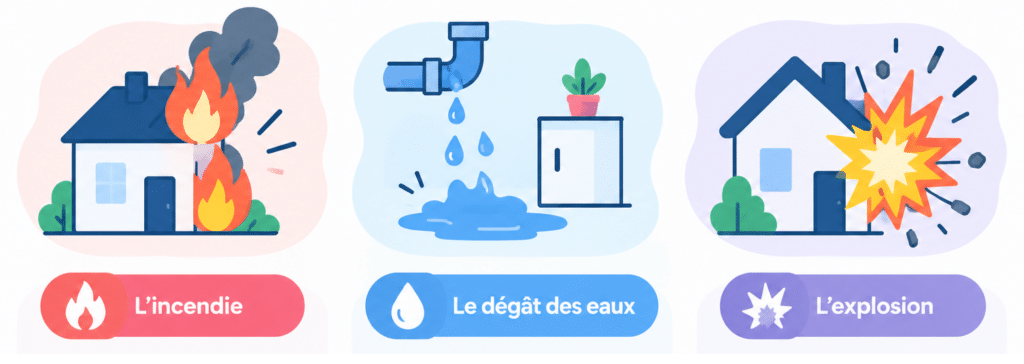
Be careful, though: the conditions on which claims are paid, the exclusions and the excesses vary from one policy to another. So it is important to read the cover rather than rely on the name of the product alone.
Rental risks and civil liability: what is the difference?
This is an important point to understand when choosing your insurance.
Rental risks and private life civil liability do not cover exactly the same situations.
Rental risks concern the damage caused to the property you occupy. Private life civil liability, for its part, can cover certain accidental damage you cause to other people, within the limits set out in your policy.
For example, if you accidentally cause damage at a neighbour’s, your civil liability can step in depending on the circumstances and the cover taken out.
These two protections are therefore complementary.
Many home insurance policies include civil liability cover, but you should not assume it automatically. Check precisely which cover is stated in the terms of your product.
Are your personal belongings covered?
Insuring your home does not necessarily mean that all your belongings are protected.
As a student, you probably own several items that matter day to day: a laptop, a phone, clothes, a games console or course materials.
Depending on the policy chosen, some of these belongings may be covered in the event of a claim, while other situations may be excluded or subject to particular conditions.
Before taking out a policy, ask yourself a few questions:
Are my electronic devices covered in the event of fire or water damage?
Are my belongings insured only inside the property?
Is theft covered? If so, on what conditions?
Is there a compensation limit for my personal belongings?
Do I have to pay an excess in the event of a claim?
These checks will help you understand the level of protection you have.
You do not necessarily need to choose every option available. The aim is to select insurance that matches the value of your belongings and your real needs.
How do you choose suitable student home insurance?
Not all products are equal. To make the right choice, do not look only at the advertised price.
Here are the three essential criteria to weigh up.
The type of accommodation
A room in university halls and a student flat do not necessarily have the same characteristics.
Check that the policy does match your accommodation, its floor area and its situation. Also consult the requirements communicated by your CROUS residence.
The cover included
Compare the basic cover and the additional protection offered. Make sure in particular that you understand the cover for rental risks, civil liability and the possible protection of your personal belongings.
The budget
As a student, your budget is often limited. So it is worth comparing several products to find a good balance between price and level of protection.
A cheaper policy may be enough for your needs, but it may also contain more exclusions or lower compensation limits.
The best choice is not necessarily the cheapest insurance: it is the one that meets your accommodation’s requirements while offering the cover you really need.
CROUS insurance: what to do before you move in
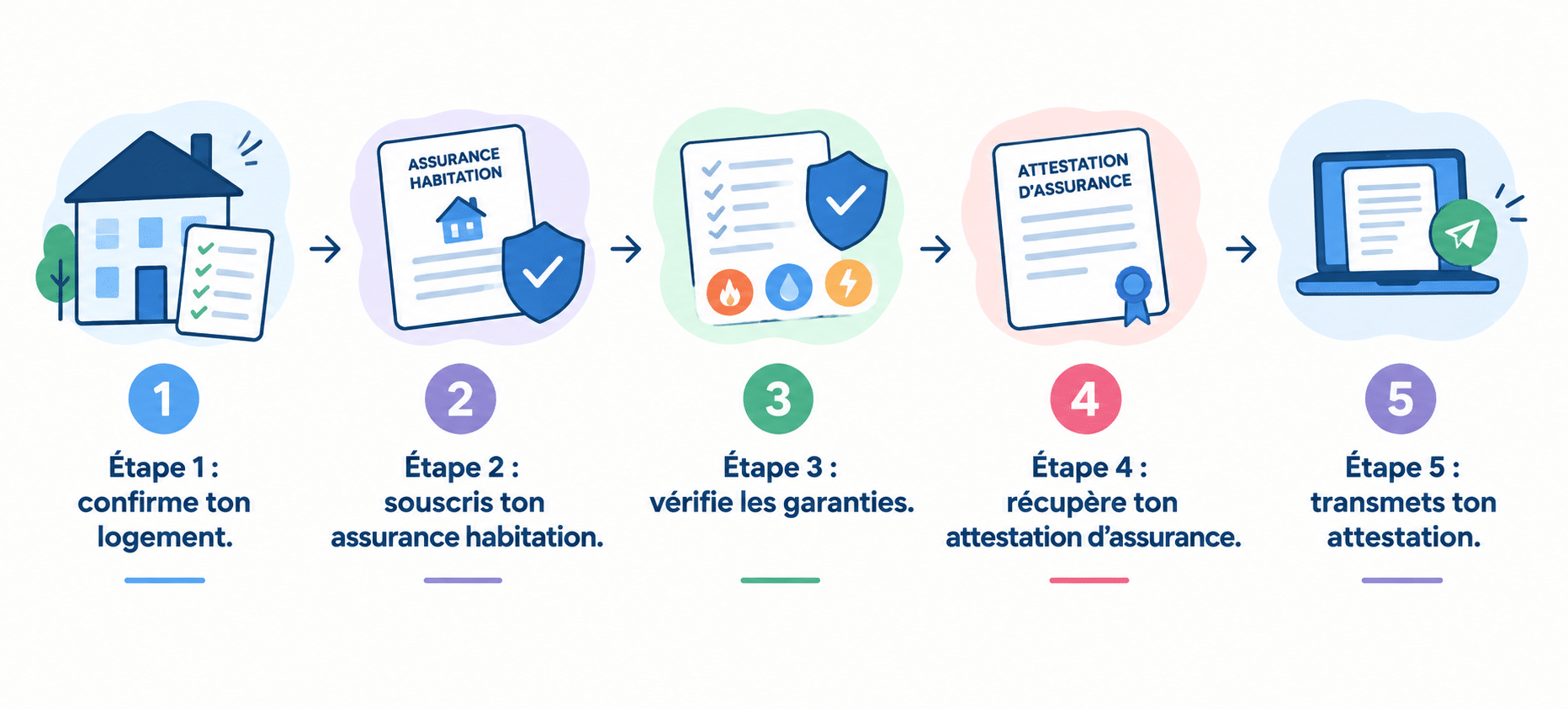
To avoid any nasty surprises when you collect your keys, follow this checklist.
Step 1: confirm your accommodation.
Check the information about your residence and the documents required for your rental file.
Step 2: take out your home insurance.
Choose a policy suited to your student accommodation and to the start date you need.
Step 3: check the cover.
Make sure the rental risks are covered and examine the other cover included in your policy.
Step 4: get your insurance certificate.
This document must match the accommodation concerned and the period required.
Step 5: send your certificate.
Send the evidence in the way indicated by your residence or by the managing service.
Remember too to keep a copy of your certificate and your policy so that you can find them easily if you need them.
To sum up:
Which mistakes should you avoid when insuring your student accommodation?
A few mistakes can complicate your move.
Waiting until the last day: you risk not having time to compare products and get your certificate.
Choosing on price alone: an attractive price does not guarantee suitable cover.
Confusing rental risks with civil liability: these covers do different things.
Assuming your personal belongings are covered: check the cover, the limits and the exclusions.
Forgetting to check the cover date: make sure the policy takes effect when you need it to.
By planning these steps ahead, you will be able to focus on what matters: settling in and starting your academic year.
Conclusion: arrange your insurance before you collect your keys
Getting CROUS accommodation is an important step in student life. To move in with peace of mind, home insurance should be one of the steps you plan ahead.
Start by checking your residence’s requirements, then choose a policy that covers rental risks and examine the additional cover you might need. Do not forget to get your certificate and send it within the deadlines required.
In short, confirm your accommodation, take out your insurance, check your cover and get your certificate ready before you move in.
A few checks beforehand can save you a great deal of trouble when the keys are handed over.
Frequently asked questions about CROUS accommodation insurance
-
L’assurance est-elle obligatoire dans une résidence CROUS ?
Oui. L’assurance habitation est obligatoire pour tout locataire d’un logement CROUS, comme pour n’importe quel logement en France. Le CROUS peut vous demander une attestation lors de la remise des clés. Sans assurance, vous seriez personnellement responsable des dommages causés à vos voisins ou au logement.
Avec Etudassur, vous recevez votre attestation MRH immédiatement après la souscription — pratique pour la réunion de remise de clés.
-
Quelles garanties sont incluses dans la formule CROUS ?
La formule CROUS comprend :
- Incendies et événements assimilés (4 500€, franchise 100€)
- Événements climatiques (4 500€, franchise 228€)
- Dégâts des eaux (4 500€, franchise 100€)
- Catastrophes naturelles et technologiques
- Attentats et terrorisme
- RC Locataire (10 000 000€)
- RC Vie Privée, scolaire et extrascolaire en option (10 000 000€)
⚠️ La formule CROUS n’inclut pas : bris de glace, vol, perte de clés, punaises de lit, dommages électriques.
-
Comment fournir mon attestation d’assurance au CROUS ?
Votre attestation MRH est envoyée automatiquement par email dès la validation du paiement.
Vous pouvez aussi la télécharger à tout moment depuis votre espace client (assure.etudassur.fr → « Mes documents »).
Si le CROUS demande une attestation avant votre arrivée, souscrivez en ligne la veille ou le jour même de la remise des clés — vous recevez l’attestation en quelques minutes.
-
Que couvre la responsabilité civile en logement CROUS ?
La Responsabilité Civile Locataire vous protège si vous causez des dommages matériels au logement ou à vos voisins.
La Responsabilité Civile Vie privée, Scolaire et Extrascolaire Vie Privée couvre les dommages causés en dehors du logement dans le cadre de votre vie privée ou lors de vos études.
La RC est la garantie la plus importante — sans elle, vous seriez personnellement responsable de dommages pouvant atteindre plusieurs centaines de milliers d’euros.
-
Quelle durée de contrat choisir pour un logement CROUS ?
Les durées disponibles sont 3, 6 ou 12 mois (9mois + 3 mois offerts).
Pour un logement CROUS typique (une année universitaire), la durée 12 mois est la plus adaptée. Si vous n’occupez le logement qu’un semestre, optez pour 3 ou 6 mois.
Le contrat est à durée ferme sans tacite reconduction — il n’est pas reconduit automatiquement. Pensez à renouveler avant la fin.
La durée minimale est de 3 mois — pas de contrat au mois possible.

Florian Cau
Assistant de production d'Etudassur depuis 5 ans, je suis à votre service pour répondre au mieux à vos interrogations et vous accompagner avec votre contrat Etudassur.